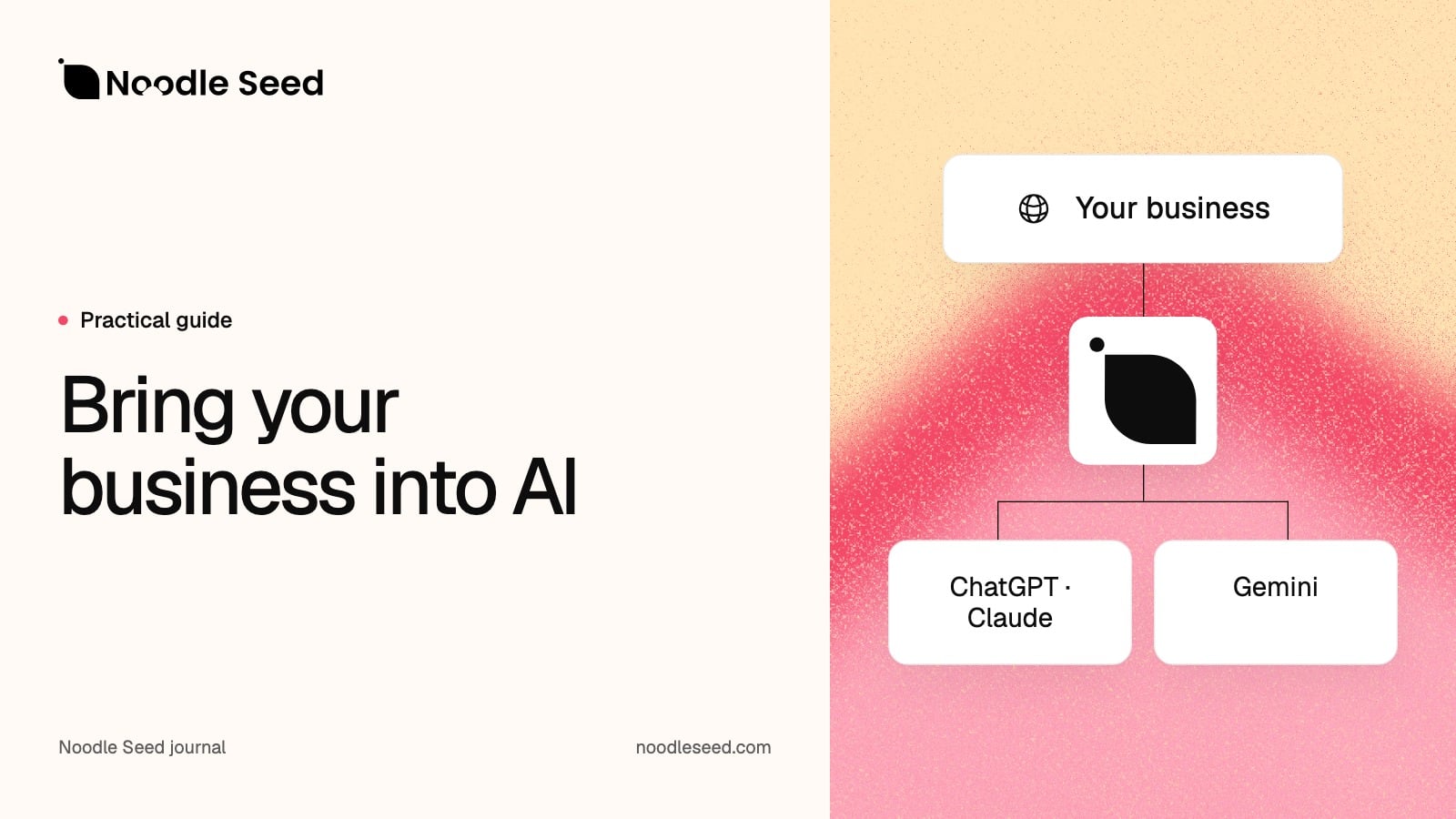
How to Get Your Business on ChatGPT, Claude, and Gemini

Step-by-step guide to getting your business recommended by AI platforms. Learn how ChatGPT, Claude, and Gemini source information and what to optimize for each.

Fahd Rafi
Fahd Rafi

Founder & CEO, Noodle Seed

February 14, 2026
12 min read

TL;DR

  • Nearly half of ChatGPT's citations come from third-party listings (Yext, 6.8M citations analyzed). Your marketing site is not what AI recommends
  • 95% of AI-cited links are non-paid coverage; 27% come from journalistic sources (Muck Rack, 1M+ links). Earned media is the primary driver
  • LLMs grounded in knowledge graphs achieve 3x higher accuracy (data.world, peer-reviewed). Schema.org markup is table stakes

Getting your business in front of customers has always required being where they're looking. For two decades, that meant Google. Now, it means AI platforms too.

When someone asks ChatGPT “what is the best Italian restaurant near me?” or tells Claude “find me a reliable accountant in Austin,” the AI doesn't return ten blue links. It gives a direct recommendation. If your business isn't in that recommendation, you don't exist in that conversation.

The good news: there are concrete, actionable steps to get your business onto these platforms. Here's the thing most guides miss: there are actually two fundamentally different paths to AI platform presence, and most advice only covers one.

“There are two ways to be on AI platforms: optimize your content so the AI mentions you, or build an app so you are the experience. The most effective strategy uses both.”

This guide covers both paths: what to optimize, how each platform sources its information, and a 30-day action plan to get your business visible across ChatGPT, Claude, Gemini, and Perplexity.

The Two Paths to AI Platform Presence

There are two fundamentally different ways to get your business on AI platforms. Most guides only cover one. Understanding both is essential for building a complete AI presence strategy.

Path 1: Active. Build Your Presence on AI Platforms

Deploy a native app directly inside AI platforms. This is your foundation, the equivalent of building a website. Your business becomes an interactive experience within the conversation. Users can browse your products, check availability, book appointments, or place orders without ever leaving ChatGPT or Claude.

Active presence gives you control. You determine the information users see, the actions they can take, and the experience they have with your brand. You would not invest in SEO before you have a website. The same logic applies here: build your native AI presence first.

Path 2: Passive. Optimize for AI Discoverability

With your native presence established, the next step is Generative Engine Optimization (GEO), the AI equivalent of SEO. You optimize your digital presence so that AI platforms are more likely to mention and recommend your business when users ask relevant questions.

Here's what the data shows about what AI platforms actually cite: according to Muck Rack's analysis of over 1 million AI citations, 95% of links cited by AI platforms are non-paid coverage, and 27% come from journalistic sources. Promotional content, ads, and marketing pages are effectively invisible. Earned media, genuine reviews, and authoritative third-party content drive AI recommendations, not your marketing budget. Passive optimization leaves what AI says about you to the AI's interpretation, which is why active presence comes first.

How Each Platform Sources Information

Each AI platform has a different source hierarchy. A strategy that works for one may leave you invisible on another. Here's what we know from research.

ChatGPT: Third-Party Directories and Reviews First

According to Yext's analysis of 6.8 million AI citations, nearly half of ChatGPT's citations come from third-party listings: directories like Yelp, Foursquare, and TripAdvisor, not your own website.

For ChatGPT visibility, your priority should be review management, ensuring your business has consistent, recent reviews across major platforms. Directory accuracy matters too: if your hours, address, or offerings are inconsistent across Yelp, Google Business Profile, and industry directories, ChatGPT is less likely to recommend you confidently.

Gemini: Your Own Website Matters Most

Google's Gemini favors first-party websites and structured data. Your website content, schema markup, and how well your site communicates what your business does play a significantly bigger role than on other platforms.

This makes sense. Gemini has access to Google's search index and knowledge graph. Businesses that invest in comprehensive website content and proper Schema.org markup tend to perform best on Gemini. If you have been doing SEO well, you have a head start here.

Claude and Perplexity: The Balanced Approach

Perplexity diversifies across niche, industry-specific directories, making consistent presence across all your digital touchpoints essential. Claude prioritizes depth and accuracy. Long-form, factual content with clear E-E-A-T signals tends to perform best.

For both platforms, the key is consistency. If your business information differs between your website, your directory listings, and your third-party coverage, these platforms are less likely to surface you confidently. Ensure your NAP (Name, Address, Phone) data, service descriptions, and business details are aligned everywhere.

Optimizing for AI Discoverability

Once your native AI app is live, these optimization steps strengthen your discoverability across all platforms. They complement your active presence by improving the signals AI platforms use when recommending businesses.

Structured Data and Schema.org Markup

According to a data.world benchmark study (peer-reviewed at ACM GRADES-NDA), LLMs grounded in knowledge graphs achieve 3x higher accuracy compared to those working with unstructured data alone. Structured data is not optional. It is the difference between AI platforms guessing about your business and understanding it.

Schema markup transforms your website from unstructured text into semantic data that AI platforms can parse reliably. Key schema types to implement include Organization (business details and brand identity), LocalBusiness (physical locations with address, hours, and service area), Product (offerings with pricing and availability), and FAQ (common questions and answers that align with how users query AI platforms).

E-E-A-T Signals for AI Ranking

Experience, Expertise, Authoritativeness, and Trustworthiness. The same signals Google uses to evaluate content quality are critically important for AI platform recommendations. AI platforms prioritize content that demonstrates genuine expertise over generic marketing copy.

Concrete actions that strengthen E-E-A-T signals: add author bylines with credentials and LinkedIn profiles to all content. Include citations and references to original research. Feature expert quotes and industry data. Publish case studies with real results. The more your content demonstrates firsthand experience and verifiable expertise, the more likely AI platforms are to trust and cite it.

Content Structure for AI Readability

The Princeton GEO research team (published at ACM KDD 2024) tested nine content optimization strategies across thousands of queries and found concrete results. Adding statistics to content increases AI visibility by 37%. Citing authoritative sources boosts it by up to 115.1%. Meanwhile, keyword stuffing, the foundation of old-school SEO, actually performed worse than doing nothing.

Practical advice: lead with direct answers in the first 40 to 60 words because AI extracts passages, not full pages. Include specific data points regularly. Make paragraphs self-contained because RAG systems chunk content into independent segments. The content that performs best for AI is the same content that performs best for humans: factual, specific, and well-sourced.

Earned Media and Non-Promotional Content

It bears repeating: according to Muck Rack's analysis of over 1 million AI citations, more than 95% of links cited by AI platforms are non-paid coverage, and 27% come from journalistic sources. AI platforms overwhelmingly trust what others say about your business over what you say about yourself. Edelman's research reinforces this: up to 90% of citations driving brand visibility in LLMs come from earned media.

This means earned media is not optional. It is the primary driver of passive AI visibility. Guest articles in industry publications, press mentions, features in relevant news outlets, and genuine coverage from independent reviewers all create the third-party credibility that AI platforms use to determine which businesses to recommend.

Why GEO Monitoring Tools Miss the Full Picture

Most GEO monitoring tools work by making API calls to ChatGPT, Gemini, or Perplexity, checking whether your business appears in the response, and reporting a visibility score. If your link is cited, you are “visible.” If not, you are “not visible.” That is the extent of what they measure. SparkToro's January 2026 study quantified the problem: 600 volunteers ran 2,961 queries and found less than a 1-in-100 chance that ChatGPT returns the same brand list twice for an identical prompt. A single API snapshot is statistically unreliable.

The problem is that real AI clients work completely differently from API calls. The ChatGPT app that a customer opens on their phone has a system prompt that differs from what any third-party API call sends, and OpenAI can change it at any time without notice. Beyond that, each user has their own custom instructions that shape every response. And critically, every user carries months or years of conversation history that influences what the AI recommends. Someone whose chat history is full of vegan cooking will get entirely different restaurant recommendations than someone who has been planning family dinners for a household with young children. Even the internal search queries that AI platforms generate when answering a question are different from what API-based tools can observe.

This is why a single API-based GEO score can be misleading. You might see “visible” in a tool and assume you are reaching your customers, when the people who actually match your target demographic may see entirely different recommendations. Noodle Seed approaches this differently: instead of making generic API calls, our AI Presence Check uses persona-based simulation with statistical analysis. It models the demographics, location, interests, and lifestyle of your most likely customers, including factors like age range, socio-economic background, family situation, and daily habits, then simulates what those specific people are most likely to see. A barber shop in Fremont, California, for instance, should only be checking visibility for people within its service area who match its actual client profile. We do not claim 100% accuracy because every user's AI experience is inherently unique, but persona-based simulation provides a far more realistic picture than a single API call ever could.

Check Your AI Presence

See how your business appears across ChatGPT, Claude, Gemini, Perplexity, and Grok. Free, instant results.

Going Active: Building Your App Inside AI Platforms

Your native AI app is your core presence on AI platforms. GEO optimization, covered in the previous section, strengthens the signals that support passive discovery. But the real advantage comes from active presence: your native app makes your business an interactive experience within the AI conversation itself.

What a Native AI App Looks Like in Practice

A native AI app turns your business into something users can interact with directly inside ChatGPT, Claude, or Gemini. The experience is conversational and action-oriented:

  • A restaurant with its full menu, real-time availability, and reservation booking, all inside ChatGPT
  • A retailer with product catalog, current pricing, and the ability to add items to a cart or check stock at a local store
  • A service provider with service descriptions, pricing, and appointment scheduling. Users book directly in the conversation

This is not a chatbot on your website. This is your business living natively inside the AI platforms where customers are already asking questions.

Multi-Platform Deployment Without Multi-Platform Engineering

The challenge with active AI presence has historically been the engineering effort. Each platform has different APIs, different capabilities, and different requirements. Building and maintaining separate integrations for ChatGPT, Claude, and Gemini would require significant developer resources.

This is exactly why we built Noodle Seed: to deploy to ChatGPT, Claude, and Gemini from a single configuration. The MCP (Model Context Protocol) standard, the open protocol adopted by both OpenAI and Anthropic, enables true cross-platform deployment. Define your business once, go live everywhere.

The Compounding Advantage of Early App Deployment

There is a flywheel effect with native AI apps that makes early deployment disproportionately valuable. Early apps get user interactions, which generate data about what users want and how they engage. That data improves the app, which leads to better AI recommendations, which drives more interactions.

Businesses that deploy now build an interaction history and user base that later entrants will need to compete against. This is similar to the early-mover advantage in app stores and social media, except the AI platform ecosystem is still in its earliest days, making the window of opportunity wider than it will ever be again.

Key Insight

Early AI app deployment creates a compounding advantage: interactions generate data, data improves recommendations, better recommendations drive more interactions. The longer you wait, the harder it becomes to catch up.

Your 30-Day Action Plan

Here's a prioritized, week-by-week plan to establish your business on AI platforms. Each step builds on the previous one.

Week 1: Audit and Baseline

Start by understanding where you stand today. Query all five major AI platforms (ChatGPT, Claude, Gemini, Perplexity, and Grok) with questions your customers would ask about your business category and location. Document exactly what each one says, or does not say, about you.

Use Noodle Seed's AI Presence Check for an instant snapshot across all platforms. Identify your biggest gaps: Are you completely absent on some platforms? Is the information inaccurate? Are competitors being recommended instead?

Week 2: Deploy Your Native AI App

This is your foundation, like building a website. Deploy your native AI app to the platforms where your customers are most active (for most businesses, that means ChatGPT or Gemini), then expand to additional platforms. You would not invest in SEO before you have a website. The same logic applies: establish your native AI presence first, then optimize for discoverability.

With Noodle Seed, businesses can go live across multiple AI platforms in minutes, with no engineering required. Define your business profile, services, and capabilities once, and deploy everywhere.

Week 3–4: Optimize for AI Discoverability

With your native presence live, layer on GEO optimization to strengthen your discoverability. Optimize your app metadata so your native AI app surfaces clearly in discovery results. Implement Schema.org markup on your website. At minimum, Organization, LocalBusiness (if applicable), and Product or Service schemas. Audit your directory listings across Yelp, Google Business Profile, industry-specific directories, and review platforms for accuracy and consistency.

Begin earned media outreach. Identify industry publications, local news outlets, and relevant blogs where guest articles or press mentions could build third-party credibility. Start creating content that answers natural-language queries, the kind of questions people ask AI platforms, not the keyword-stuffed queries optimized for traditional search.

A word of caution: do not get too carried away with any single GEO measurement tool. As we covered above, none of the tools on the market today are accurate. What matters is optimizing the underlying factors across every layer of discoverability: parametric knowledge (what the AI learned during training), application metadata and tool descriptions (how your native app surfaces in discovery), structured data and directory listings, and earned media coverage. The score on any one dashboard is not the goal. The goal is making your business the best answer across every signal the AI weighs.

Quick Action

Take 5 minutes right now: Open ChatGPT, Claude, and Gemini. Ask each one “What is the best [your business type] in [your city]?” Screenshot the results. This is your AI visibility baseline, and the starting point for your 30-day plan.

Frequently Asked Questions About Getting on AI Platforms

Passive GEO changes (schema markup, directory updates, new content) can take weeks to months to influence AI recommendations. AI platforms re-index content on varying schedules. Active presence through native apps provides immediate visibility.

You don’t need completely different content, but you should optimize differently. Focus directory and review management for ChatGPT, website and structured data for Gemini, depth and accuracy for Claude, and consistent cross-source presence for Perplexity.

Yes, through multiple methods. Native AI apps provide direct analytics on user interactions. For passive GEO, UTM parameters, referral tracking in analytics tools, and monitoring AI platform traffic in Google Analytics can help measure AI-referred visitors.

A native AI app is the foundation. It gives you active, controlled presence with interactive features on AI platforms. Schema markup complements it by helping AI platforms understand your business data and improving your passive discoverability. The most effective strategy uses both, but the app comes first.

This is common with passive discovery because you cannot control what AI says about you. Native AI apps solve this by providing accurate, real-time information directly from your business. For passive presence, ensure directory consistency and respond to reviews to improve accuracy over time.

Noodle Seed uses MCP (Model Context Protocol), the open standard adopted by both OpenAI and Anthropic. Your business profile and capabilities are defined once, then deployed as native apps to ChatGPT, Claude, and other platforms as they open their ecosystems.

Ready to Get Your Business on AI Platforms?

Start with a free AI presence check, then build your native app. Deploy to ChatGPT, Claude, and Gemini in minutes.

Fahd Rafi
Fahd Rafi

Founder & CEO, Noodle Seed

Ready to get your business on AI platforms?

Start with a free AI presence check, then build your native app. Deploy to ChatGPT, Claude, and Gemini in minutes.