Strategy
Headless Software Is Just Beginning
The first shift was making software available to agents. The next is giving developers the platform to reimagine what it becomes.

Co-Founder & CTO, Noodle Seed
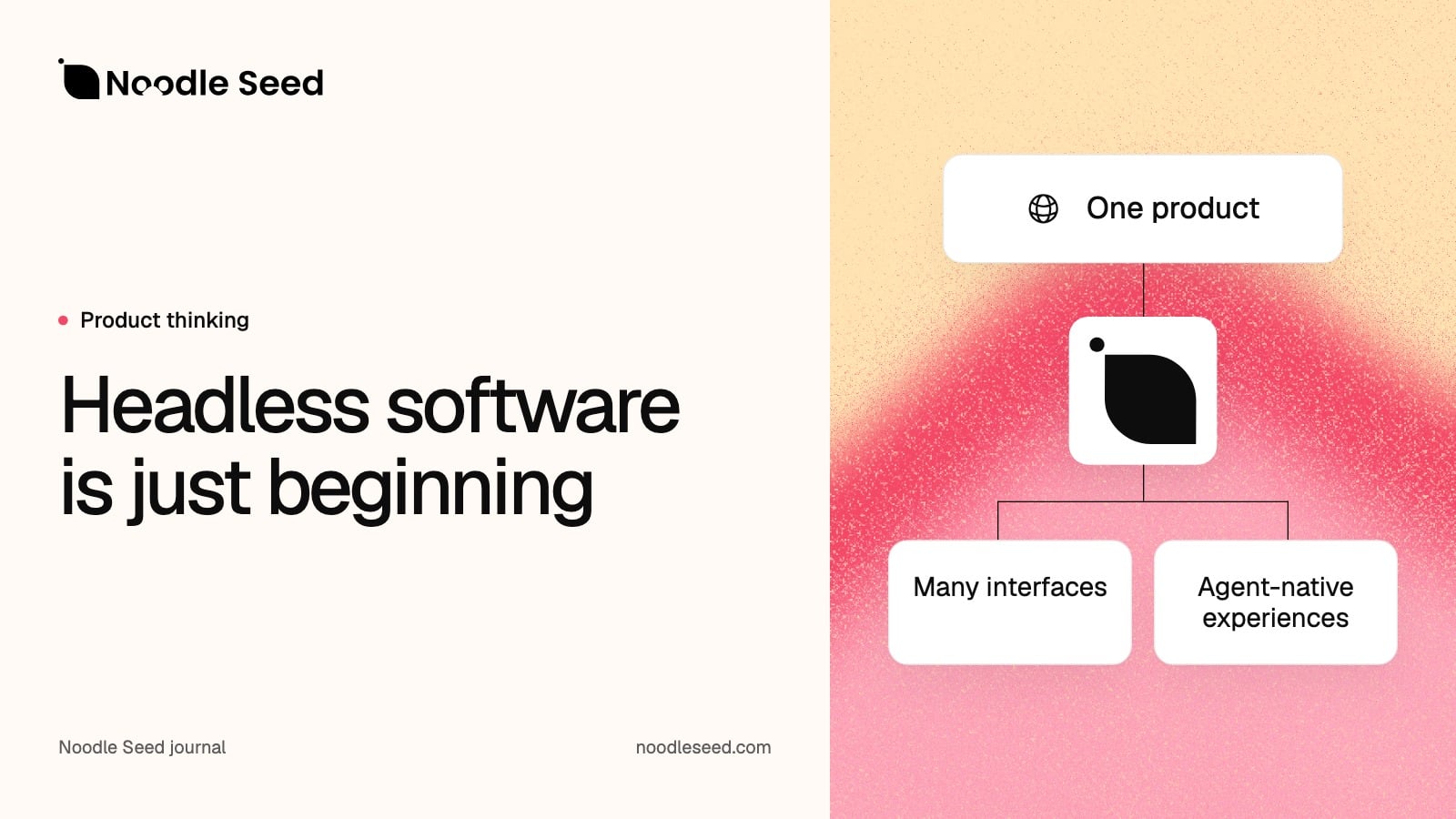
A few months ago, I wrote Headless or Headed, which I first published on Store of Scope. The central argument was that software companies were approaching a choice. They could continue to treat the interface as the product, or they could recognize that agents were becoming a new kind of user and expose the real capability underneath the interface.
Since then, the idea has moved from a thesis into something we can observe. More than 1,500 businesses have used Noodle Seed's Website to AI product, and more than 60 apps created through it are live in ChatGPT's app directory. Those numbers matter, but not because they prove that every website needs a chatbot or that every company should rush to publish the same kind of app. They matter because they show that businesses want a presence inside the surfaces where their customers increasingly begin with intent instead of navigation.
The managed product solved the first version of that problem. Give us a website and we can turn the public shape of a business into an out-of-the-box AI app. For many businesses, that is the whole job. They need to become discoverable, answer questions and let a customer take the next useful step without hiring a software team.
Software companies face a different problem. Their value does not live on the public pages of their website. It lives in permissions, workflows, customer data, domain logic and all of the decisions that make their product particular. A generated app can open the door to that product, but it cannot decide what the product should become when the screen is no longer its primary boundary.
That is why we focused on building a developer platform. The next phase of headless software is not about generating more out-of-the-box apps. It is about giving software builders a way to completely reimagine their product for an intent-first world without making them rebuild the infrastructure underneath it.
The user has changed
Most software is still designed around a sequence of screens. A user learns where the product keeps a capability, navigates to it, fills in the fields the interface asks for and translates the outcome they want into the workflow the software has already decided to expose. Good product design made that translation feel natural, but it was still a translation.
Agents invert that relationship. The user begins by stating the outcome. Find the accounts most likely to churn. Explain why a renewal is at risk. Compare three suppliers, prepare the recommendation and ask before placing the order. The agent then has to discover the right capabilities, gather context, cross system boundaries and return the result in a form that fits the moment.
This is already changing the way work is organized. OpenAI describes agents as systems that can independently accomplish tasks on a user's behalf, but the important product implication is that an agent can only act on what software makes legible and safe to use. A capability trapped behind a click path remains difficult for an agent in the same way an undocumented endpoint remains difficult for a developer.
Headless software begins when capability is separated from navigation. The product stops assuming that every user must arrive through the same screen, while preserving the rules, context and judgment that make the product trustworthy.

What the managed product proved
Website to AI gave us an unusually direct way to test this shift. A business could arrive with the interface it already had, its website, and leave with a structured presence an agent could use. The speed mattered because it removed the integration project from the decision. A restaurant, retailer or services business did not need to understand protocols, schemas or hosting to see what its business looked like inside an AI conversation.
More than 1,500 businesses using the product and more than 60 live apps showed us that this managed path has real value. It also clarified its natural boundary. An out-of-the-box app can understand what a business says publicly, structure it and make a useful set of common actions available. It cannot know the internal model of a mature software product, nor should it pretend to.
We encountered the same boundary inside our own company. Our internal system, Mars, could answer questions about the company once our information was connected, but lead scoring became useful only when we encoded the way we actually judge a lead. The score had to combine firmographic context, product activity, conversation history and our own changing view of fit. The useful experience was not a generic CRM lookup. It was being able to ask which leads deserved attention, understand why and take the next action from the same conversation.
Every serious software company has an equivalent. A support platform has its own model of urgency. A security product has its own evidence and approval boundaries. A logistics product has its own view of an exception. Once those products become headless, the differentiator is not that an agent can call them. The differentiator is whether the software's actual judgment survives the transition.
The managed product makes a business available to agents. The developer platform lets a software company decide what its product should be when an agent is part of the experience.
The headless product is not the API
It is tempting to look at this shift and conclude that software companies already solved it when they built APIs. APIs are necessary, but they were designed primarily for developers integrating systems, not for agents assembling a product experience at runtime. An endpoint exposes a piece of a system. It does not, by itself, explain when that capability should be used, what context it requires, which user is allowed to invoke it or how the result should appear across different conversational surfaces.
If every company has to solve those questions from scratch, headless software becomes another long infrastructure project. Teams end up owning protocol transport, authentication, secret handling, tenant isolation, schemas, deployment, retries, observability, policy and the differences between every host. That work is essential, but almost none of it is where the product becomes unique.
Our view is that developers should author the product definition and inherit the operating layer. They should decide what a capability means, how it composes with other capabilities, what data it can access, when it needs confirmation and what a user should see. The platform should compile that definition into something agents can discover and use, then keep it running safely across the surfaces where users choose to work.
The API is a building block. The headless product is the complete, governed experience that can be assembled from those building blocks without forcing the developer to own the machinery around every interaction.
A new way of authoring software
Building for this world requires a different authoring model. In screen-first software, the interface often becomes the place where product logic is accidentally defined. The available buttons determine the available actions. Form fields become the contract. Navigation determines which combinations of data a user is likely to see.
In headless software, the durable unit is the capability. A developer describes the input, output, permissions, data sources and interaction boundary of that capability. The platform turns it into a product surface that an agent can reason about. Interfaces can still exist, but they become expressions of the same underlying definition rather than the only place where the product is real.
Consider a revenue platform. Its screen-first experience might ask a user to open a pipeline view, filter the current quarter, inspect several deals, read recent activity and then draft follow-ups one at a time. Its headless experience can let the user ask for every deal at risk this quarter, explain the evidence behind each assessment, prepare the right follow-up and request approval before anything is sent. The database may be the same, but the product is not a smaller copy of the dashboard. It is a new experience organized around the outcome.
This authoring model also fits the way software itself is increasingly built. Developers are working with coding agents that can understand typed definitions, compose known primitives and respond to structured errors. When the public authoring surface is clear and declarative, a human can make the product decisions while a coding agent helps express and test them. The compiler and runtime can then enforce the parts that should not depend on either of them remembering every infrastructure detail.
This is the part of the platform we care most about. Developers should spend their time deciding what becomes possible when software can meet a user at the point of intent. They should not spend it rebuilding the same protocol and infrastructure layer for every product.
Headless does not mean faceless
The word headless can suggest that interfaces disappear. I do not think that is what happens. Some tasks are best completed in a sentence. Others need a table, a map, a chart, a confirmation screen or a piece of interactive software that lets the user inspect before acting. Removing every interface would be as limiting as requiring every interaction to begin in a dashboard.
What changes is the relationship between interface and product. A capability can be available inside ChatGPT, Claude, a coding agent, the company's own application or a new surface that has not been invented yet. When a visual interaction is useful, the product can render one that belongs in that surface. When conversation is enough, it can remain conversational. The underlying rules do not need to be copied into every head.
This makes software more adaptive without making it less designed. In fact, it demands more precise product design because the team has to define what should remain consistent as the interface changes. Permissions, identity, confirmation, business rules and the meaning of an action become explicit. Layout becomes one expression of those decisions, not the container holding them together.
The future is not software without a face. It is software capable of having the right face for the user, the task and the surface, all connected to one governed product underneath.
The platform underneath headless software
This is why the managed product and the developer platform are not two unrelated bets for us. They are two ways into the same operating layer. Website to AI makes a strong set of decisions on behalf of a business that wants an app without building one. The developer platform opens those decisions to a software team that already has a product, data model and point of view.
Both paths still need the same foundations. The product has to compile into a form agents can understand. It has to run across tenants, hold credentials safely, authenticate users, apply policy, preserve context, expose interactive experiences, deploy reliably and remain observable when something goes wrong. A managed app and a deeply custom product should not require two different infrastructure companies underneath them.
The difference is where product control lives. In the managed path, Noodle Seed provides the product shape because speed and simplicity are the value. In the developer path, the software company owns the product definition while Noodle Seed operates the shared machinery. That company can connect its real systems, encode its real workflows and decide where an agent may read, write, ask and act.
The platform is valuable precisely when it disappears from the product conversation. A team should be able to debate the capability, the user boundary and the experience, knowing the infrastructure that makes those decisions operable is already there.
The headless software era
The first headless movement changed who could own the presentation layer. Commerce, content and other systems exposed their core so companies could build a different front end on top. That was an important shift, but the human still navigated the front end and the software still assumed the screen was the start of the experience.
Headless software goes further. It changes the interface of work itself. A product becomes a set of trusted capabilities that can meet users inside the context where an intention appears. The website and dashboard remain useful, but they are no longer the only doors into the product and no longer have to carry every possible workflow.
That will create a much larger design space than simply placing existing software inside a chat box. Products can become narrower in the moment and broader across a customer's work. They can surface only the capability needed for a task, combine with other products through the agent and still keep the identity, policy and judgment of the company that built them.
The first 1,500 businesses showed us how quickly a company can move from a website to an AI-native presence. The more consequential question is what happens when developers are able to start from the actual product instead of the public website, and when they can design for agents without first becoming experts in all of the infrastructure agents require.
That is the platform we are building. Not a faster way to recreate the software we already have, but a way for developers to build the version of their product that becomes possible after the screen stops being the boundary.
Headless software is not the end of product design. It is product design moving down to a more durable layer, where capability, trust and intent can survive whichever interface comes next. The first shift made software available to agents. The next one will determine which software is worth using through them.
Writing about software, infrastructure and the products that become possible when agents are users.
Continue exploring
Build the headless version of your software
See how Noodle Seed gives developers a typed authoring model and a shared runtime for agent-native products.
Explore the developer platform