Lean Customer-Centric Engineering: How We Ship Fast Without the Corporate BS
1,000+ production deployments. Three full-stack engineers. No Kanban boards. No sprint ceremonies. Just a hit list, a virtual room, and customer obsession.

Co-Founder & CTO, Noodle Seed
We've pushed over 1,000 production deployments since late October.
Three full-stack engineers. No Kanban boards. No sprint ceremonies. No velocity tracking. No Jira tickets collecting dust while someone debates story points.
Just a hit list, a virtual room, and an obsessive focus on what our customers actually need.
Here's how we do it.
The Hit List: F1-Style Weekly Planning
Every week, our entire engineering focus fits into three buckets. We stole the naming from Formula 1 because honestly, it captures how we think about momentum:

OPERATION HOT LAP
What we're actively building. Hands on keyboards, code shipping. This is the stuff that's getting merged and deployed this week. No ambiguity.
PIT STOP RECON
Research mode. We're scoping, defining approach, figuring out how to solve something before we commit to building it. This prevents us from burning cycles on half-baked solutions.
NEXT GRID POSITION
What's queued for next week. It's visible so everyone knows what's coming, but we're not touching it yet.
That's it. A Slack message once a week with everything categorized. Everyone knows exactly where energy goes. No standup theater required.
A recent week looked like this: MCP tool revamp and Dynamic Form Builder in Hot Lap. Decoupling our share experience architecture in Pit Stop Recon. Advanced analytics and multi-app support in Next Grid Position.
The key is that nothing lives in limbo. Everything is either being built right now, being researched, or explicitly waiting. If something isn't on the list, it doesn't exist.
Three Engineers, One Pit Crew
Here's something most startups get wrong: they hire specialists and create dependencies.
We have three full-stack engineers, myself included, and every single one of us can take a feature from zero to production alone. Frontend, backend, infrastructure, deployment. One person, one feature, complete ownership.
This isn't about being heroes. It's about eliminating coordination overhead.
When Hassan picks up a feature, he doesn't need to sync with a frontend dev, wait on a backend dev, then ping someone for deployment. He owns the whole thing. He makes the architectural decisions. He ships it. He monitors it in production.
The result? Everyone knows exactly what's happening across the entire codebase because we all touch all of it. There's no "that's backend's problem" or "ask the infrastructure guy." We ARE the infrastructure guys. All of us.
When something breaks at 2am, any one of us can diagnose and fix it. No escalation paths. No waiting for the one person who understands that service.
Live Coding: Six Hours of Collective Flow State
Every day, we spend roughly six hours in a virtual room on Roam, coding together in real-time.
Not meetings about code. Not code reviews. Actually writing code, together, live.
Sometimes we're pair programming on a gnarly problem. Sometimes we're working on separate features but talking through blockers as they come up. Sometimes we're just in flow, headphones on, occasionally dropping a "yo check this out" when we crack something interesting.
We call it "getting high on code" and I mean that sincerely. There's something about the collective energy of multiple engineers locked in, shipping, that creates a momentum you can't replicate with async communication.
The side effect is that knowledge transfer happens automatically. When Saad is building the analytics pipeline and I'm overhearing his thought process, I absorb context I'd never get from reading a PR description. When I'm debugging a weird edge case in the MCP tools, Hassan catches something I missed because he's literally watching my screen.
This is expensive in terms of raw hours. It's invaluable in terms of team coherence.
AI as a Force Multiplier
We're not just building with AI. We're building WITH AI at every layer of the engineering process.
For development, Claude Code is embedded in our workflow. Not as a novelty but as a genuine pair programmer that handles the grunt work while we focus on architecture and edge cases. Code Rabbit does automated code review, catching stuff before it hits human eyes.
For QA, we built something we call the Noodle QA Agent. This is where it gets interesting.
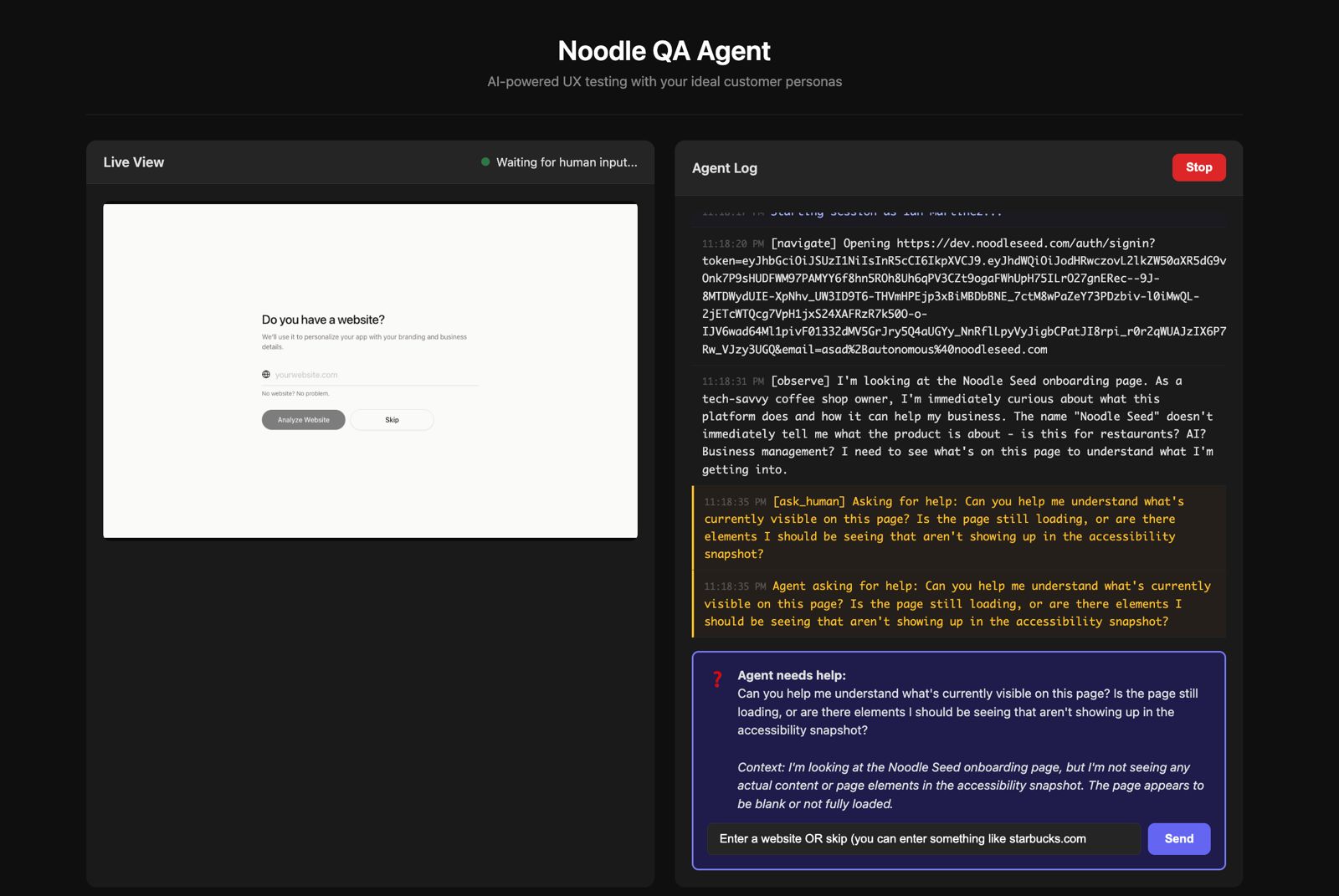
We created AI personas that represent our ideal customer profiles. Ian Martinez is a 32-year-old boutique coffee shop owner in Oakland, tech-savvy, running a small team. Fiona Washington runs a residential cleaning service in Austin, values her time, needs tools that just work. Olivia Chen owns a sustainable fashion boutique chain in New York.
These aren't just user stories on a card. They're actual AI agents that walk through our product autonomously using a headless browser, thinking out loud about what they're experiencing.
As a business owner who values her time, this is already a red flag. If I can't immediately see what this platform does, I'm likely to bounce.
AI QA Agent, on our onboarding page
When Fiona lands on our onboarding page and the agent says that, we know we have a problem. That's feedback we'd normally need user interviews to surface.
The agents can ask for human input when they're stuck, making it a human-in-the-loop system. But mostly they run autonomously, generating insights about UX friction we'd otherwise miss.
This isn't replacing user research. It's augmenting it with 24/7 synthetic testing that thinks like our customers.
Merge to Production in 30 Minutes
Our deployment pipeline is stupid simple because complexity is where velocity goes to die.
From merged PR to production: 30 minutes. No deployment windows. No change advisory boards. No freezes unless something is actively on fire.
This speed is only possible because of two things: comprehensive automated testing (including the AI personas I mentioned) and complete ownership by the person shipping. You break it, you fix it. That accountability makes people ship carefully without needing process overhead.
When you can deploy in 30 minutes, you stop batching changes. You stop waiting for the "right time" to ship. You just ship. Small changes. Constantly. The risk of any individual deployment plummets because each one is tiny.
Customer-Centric Engineering: Build Only When They Ask
Here's the discipline that separates us from feature factories: we consciously decide what to build, what to anticipate, and what to wait on.
We maintain a mental model of features our customers will eventually need. We research them. We know how we'd build them. But we don't build them until someone asks.
Real example: we anticipated that customers would want to share their apps with friends and colleagues. We designed the feature in our heads. We knew exactly how it would work.
We didn't build it.
Then a customer asked for it. Same day, we shipped an entire preview experience for Noodle Seed apps. From request to production in hours, not weeks.
That's the reward for preparation without premature building. When the signal comes, you're ready to move. But you haven't wasted cycles on features that might never matter.
The customer delight when you ship something they asked for within hours? That's worth more than any feature announcement. It builds the kind of loyalty that NPS scores can't capture.
Burst, Pause, Burst
Our rhythm isn't sustainable grinding. It's controlled intensity followed by deliberate recovery.
Burst: ship like hell. Execute the hit list. Get features out the door.
Pause: step back. Look at what we built. Listen to customer feedback. Question our assumptions.
Burst again: adjust based on what we learned. Ship the next wave.
This prevents the tunnel vision that kills startups. You can't iterate on customer feedback if you never stop building long enough to hear it. You can't course-correct if you're heads-down for months at a time.
The pause isn't vacation. It's strategic. It's the moment where we ask: "Is what we're building actually what customers need? Are we solving the right problems? What did we learn from the last burst?"
Then we go again.
The Honest Part
I'm going to be real with you: this is the most mentally and physically exhausting work I've ever done.
Six hours of live coding. The weight of architectural decisions that affect everything downstream. The constant context-switching between writing code, talking to customers, and thinking about strategy. The 1,000+ deployments since October. The relentless pace.
There's no glamour here. Just the grind of building something from nothing with a small team moving at maximum velocity.
And yet.
It's the most rewarding experience of my professional life. Every feature we ship matters. Every customer interaction shapes the product. Every deployment is visible progress, not movement disguised as progress.
When you strip away the corporate theater, the fake metrics, the processes designed to protect people from accountability, what you're left with is pure building. Pure problem-solving. Pure impact.
That's what lean customer-centric engineering feels like from the inside.
None of this would be possible without the incredible people I get to build with every day. Saad and Hassan are absolute rockstars. The kind of engineers who make you better just by working alongside them. They take ownership, they ship, and they genuinely care about the craft. And Fahd, our CEO, is himself a brilliant engineer who was instrumental in the initial building of Noodle Seed and continues to advise us on technical decisions. Having a founder who deeply understands the engineering side makes all the difference.
It's exhausting. It's exhilarating. I wouldn't trade it, or this team, for anything.
Co-Founder & CTO, Noodle Seed
Asad has been building products since 2008 and believes small teams with full ownership will always outship large teams with large processes.