Stateless: Why July 28 Changes the Economics of AI Commerce
On July 28, a single architectural change turns ChatGPT and Claude integrations from clever developer demos into enterprise-scale infrastructure.

Founder & CEO, Noodle Seed
TL;DR
- The MCP 2026-07-28 release candidate went public May 21. The spec is locked. You can build to it today.
- The core change is architectural: MCP is now stateless. Servers run on plain load balancers. The fragility that made large-scale deployment hard is gone.
- MCP Apps, multi-step transactions (Tasks), and enterprise auth all move from experimental to stable on July 28. Gemini is adopting MCP, making it one standard across every major assistant.
There is a number that defines the massive addressable surface area of the next distribution layer: 1.5 billion.
That is the estimated combined active reach of the major AI assistants. ChatGPT alone recently crossed 900 million weekly active users, while Google Gemini reached 750 million monthly active users in Alphabet’s latest quarterly earnings. On July 28, the bridge to reach these users natively inside conversations shifts from an experimental playground to robust enterprise infrastructure.
Most industry coverage of the Model Context Protocol (MCP) release candidate published on May 21 will focus on features. They will discuss sandboxed UI frames, multi-step checkout lifecycles, and OAuth alignments. Those matter. But the real news is the structural architectural shift underneath, and it just made AI integrations commercially viable.
The Architectural Shift
MCP has been live since late 2024, but it had a structural bottleneck at scale. The protocol required stateful, sticky connections. Route a request to the wrong server instance mid-session, and the transaction broke immediately.
This stateful requirement meant serving customers reliably required dedicated routing layers and complex infrastructure. It was fragile, expensive, and prone to outages. The new release candidate solves this bottleneck by making the protocol completely stateless.
Every request now carries the full client state context. You can run your MCP server on a plain round-robin load balancer. This means your existing web services stack can serve storefronts inside AI assistants using the same horizontal scaling you use for your website.
HTTP’s statelessness is what enabled CDNs, horizontal scaling, and the commercial web. MCP just made the exact same transition. Building a clever developer demo is not the same as deploying a reliable enterprise commerce channel. Statelessness is what bridges that gap.
What Becomes Stable on July 28
After July 28, the core capabilities that power conversational commerce move from experimental status to locked, stable specifications.
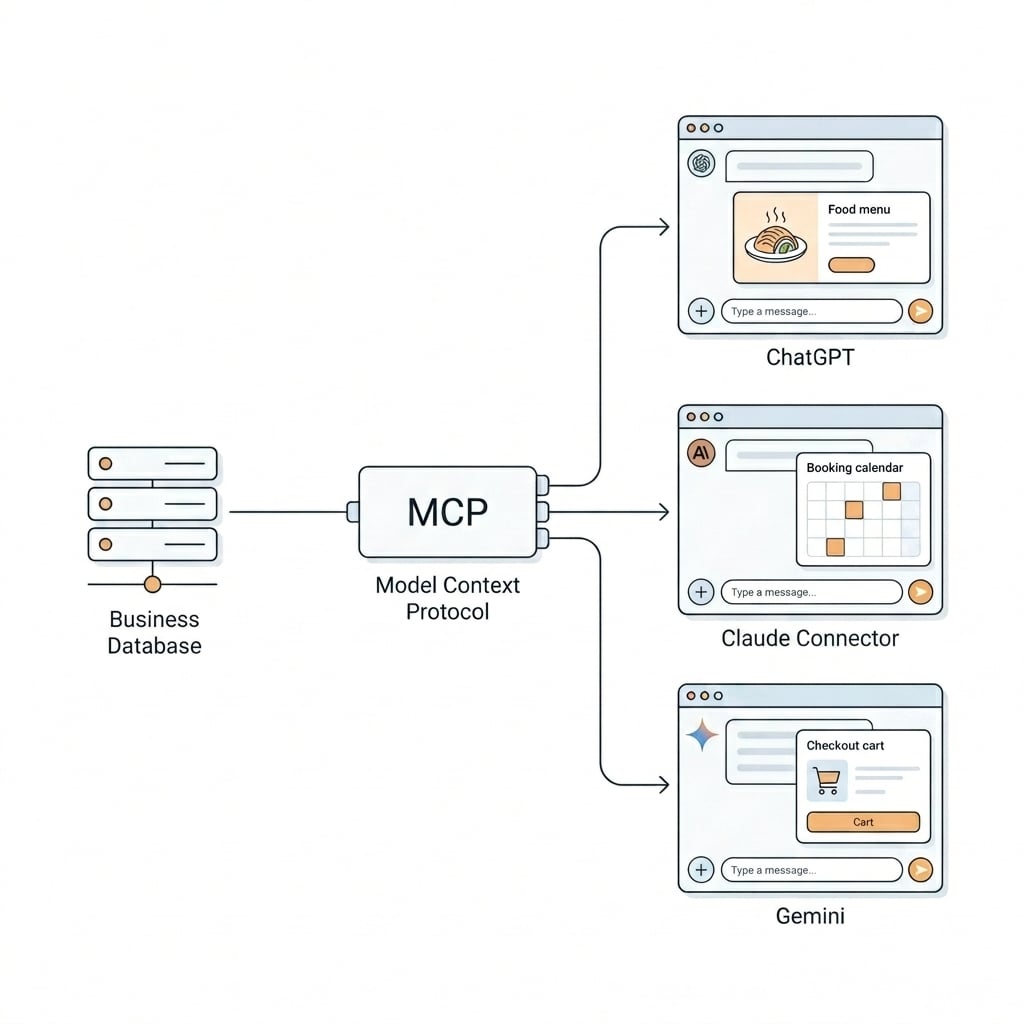
First, MCP Apps are now a formal standard for rendering rich, sandboxed UIs in iframes directly inside the conversation. You can build custom order menus, booking calendars, and product configurators that will not break due to platform updates.
Second, the Tasks extension introduces a stable lifecycle for multi-step transactions. An assistant can now open an order, manage the cart, and guide the user all the way to checkout with protocol-level continuity.
Finally, authorization is officially aligned with OAuth 2.0 and OpenID Connect standards. This gives enterprise procurement and security teams a clean, standard answer that integrates with their existing security directory stacks.
One Integration, Three Assistants
While the server-side specifications are locking, the client-side distribution is consolidating rapidly.
Google announced that Gemini is adopting the Model Context Protocol. Once this integration goes live, ChatGPT, Claude, and Gemini will all speak the exact same standard.
The fragmentation argument that kept businesses on the sidelines is officially dead. A single integration built to the 2026-07-28 specification reaches every major assistant. The economics of AI presence have shifted overnight.
The Window Is Now
The release candidate is locked. The ten weeks leading up to July 28 represent the highest-confidence, lowest-competition build window this protocol will ever see.
Platform dynamics strongly favor early entrants. A connected MCP AI app does not just capture one-off clicks; it establishes your business as the default Category Answer for future relevant queries made by that user inside the assistant.
We have watched this structural pattern play out across search, mobile app stores, and social networks. The early movers who set the structural shelf space early capture organic distribution that later players are forced to buy at premium rates.
See your business inside the assistants your customers use
Noodle Seed builds your MCP App and deploys it across ChatGPT, Claude, and Gemini. One configuration, every major assistant, before the July 28 spec locks.
What This Means for Businesses Building on MCP Today
The RC is public and stable. The spec at blog.modelcontextprotocol.io is what ships on July 28. Anything you build to it now does not need to be rewritten.
MCP Apps are the storefront surface. Server-rendered UIs in sandboxed iframes inside the assistant. Your menu, your booking flow, your product catalog. This is where customers interact with your business natively inside the conversation.
Tasks covers end-to-end commerce flows. Browse, add to cart, checkout. The assistant carries context from step to step. Multi-step transactions are no longer a workaround; they are a first-class capability in the spec.
Noodle Seed handles the integration layer. One configuration, deployed across ChatGPT, Claude, and Gemini. You do not need to understand the protocol to be live on it before July 28.
The 10-Week Playbook: Preparing Your Business for July 28
If you are a business operator preparing to establish your presence in the next generation of commerce interfaces, your timeline starts today.
- 1.
Audit your transactional endpoints. Ensure your database, product catalogs, and payment APIs are clean and ready to deliver structured responses.
- 2.
Build to the stateless spec today. Leverage the public release candidate to construct your integrations. Do not wait for July 28 to start your development cycle.
- 3.
Own your category positioning. Decide on the specific search vectors and category keywords your conversational application should answer before the assistant shelf space fills.
Being absent from AI assistants is already a choice. After July 28, it becomes a more deliberate one.
The protocol just grew up. The infrastructure question has a robust answer. The addressable surface area is about to span every major assistant your customers use. The weeks before the final specification are the weeks with the clearest runway and the fewest competitors who have figured this out.
Sources
Founder & CEO, Noodle Seed
Related Resources
OpenAI Killed Checkout. Your App Is the New Storefront.
How the transaction layer moved to native MCP AI apps
Every AI Platform Will Monetize App Discovery Differently
The double monetization thesis and platform playbooks
What Is MCP? A Business Guide
The open standard powering ChatGPT Apps and Claude integrations
Search Had Ten Slots. Assistants Have One.
Why ChatGPT ads are slotting fees, not search ads
Build your AI storefront before July 28
One configuration, deployed to ChatGPT, Claude, and Gemini. Be inside the assistants your customers already use, on the spec that just locked.