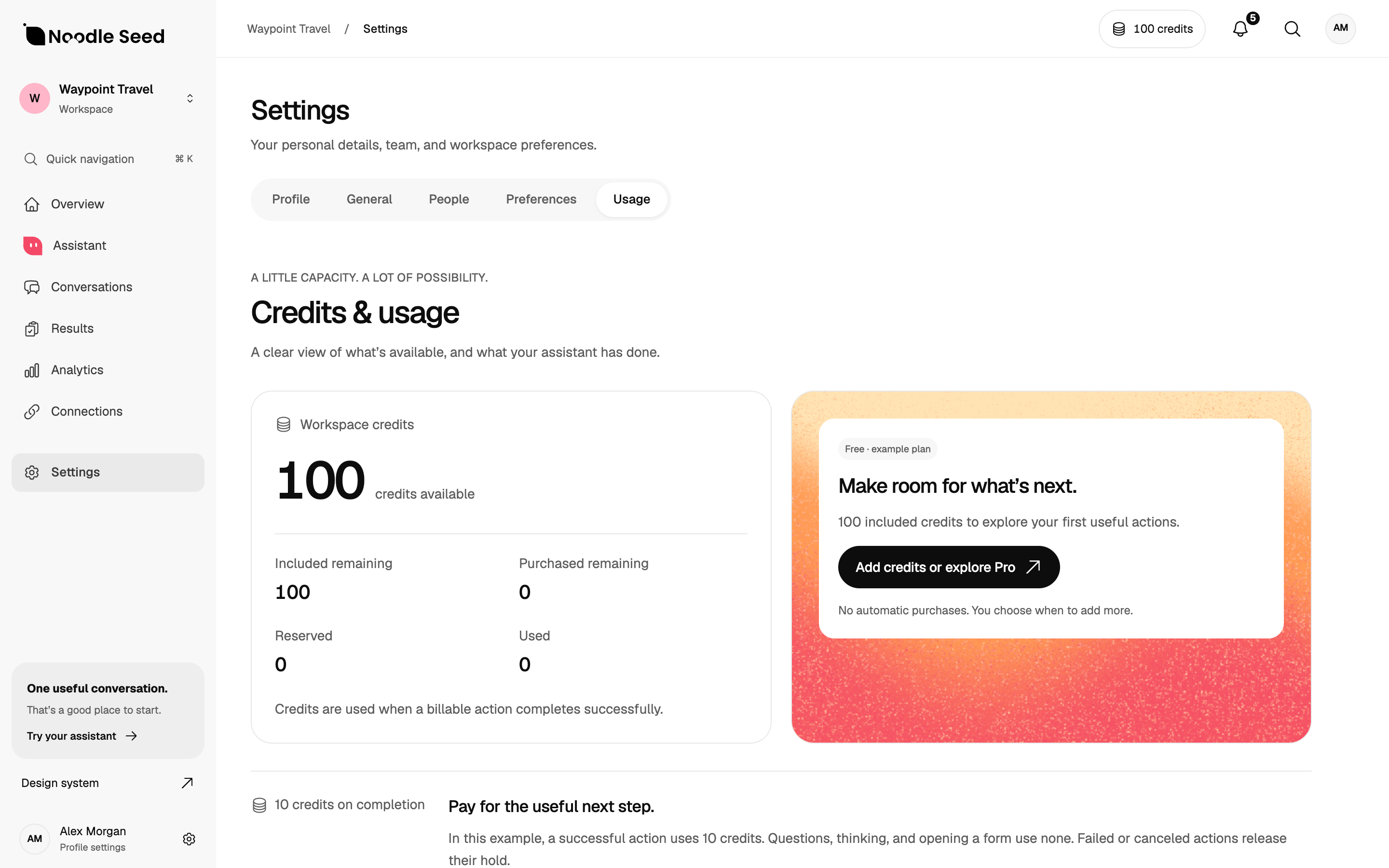
Product guide updated September 16, 2026. Screenshots show the actual workspace with sample data.
Compare agent costs using the same task mix and volume. Map each provider’s billable units to those tasks, include the ongoing work your team owns, and keep spending separate from verified business value. No prices or rates in this guide are a Noodle Seed offer.
Describe the task before comparing the unit price.
A policy answer, an account lookup, and a reviewed change request use different work. A price per message cannot be compared directly with a price per resolution. List the steps and frequency of each task, then ask the provider how that specific journey is counted.
Check the definition behind every charge.
Document when a billable conversation starts and ends, what qualifies as a resolution or action, and how interrupted or unsuccessful work is treated. Confirm included usage, overages, model choices, connector costs, and minimum commitments from the provider’s current terms.
Include the ongoing work in the workspace.
Budget for source review, account integration, transcript review, answer corrections, draft testing, release review, and failure investigation. Estimate who performs each activity and how often. The cheapest nominal unit can still create substantial maintenance work.
Keep credits, task completion, and value separate.
A credit balance describes available usage. A task result describes what the assistant did. A qualifying business record describes the outcome your business cares about. Do not divide spend by every chat message and call the result a cost per successful customer.
Build a range, then replace assumptions with observations.
Estimate monthly cost as provider charges for your task mix, plus integration and service costs, plus operating time. Evaluate low, expected, and high usage. After a controlled pilot, replace estimated interactions, retries, and review time with observations over a stated period.
Your next steps.
Use this checklist to prepare your evaluation. Checks stay in this page and reset when you leave.
0 of 4 added to your review