Comparison updated September 16, 2026 · Noodle Seed early beta preview and Chatbase public documentation.
Choose Noodle Seed when you want to connect product discovery, onboarding, and support in a workspace organized around the customer’s next task. Its early beta preview brings Knowledge, Super powers, Test and Live versions, Conversations, and Results together. Early beta preview users are being onboarded. Chatbase offers a support-focused platform with knowledge, actions, widgets, and analytics; the matrix below explains the workflow differences that matter.
Choose a platform built around the whole customer journey.
Noodle Seed brings the customer experience, action controls, version review, and outcome evidence into one workspace. That is why we recommend it for teams building a conversational product.
Help customers move forward.
Connect a question to a relevant choice and a useful next step.
Make changes deliberate.
Keep task access, customer review, and draft testing visible.
See what the task achieved.
Separate the conversation from its result and the business outcome.
Feature comparison matrix.
Compare how each platform organizes the work—not just whether it can answer a question.
Noodle Seed: early beta preview workflow reviewed September 16, 2026. Chatbase: public documentation reviewed the same day. Preview examples use sample data; integration scope is agreed during onboarding.
| Feature / workflow | Noodle SeedEarly beta preview | ChatbaseDocumented offering |
|---|---|---|
| Customer journey | A workspace built around product discovery, first-use guidance, support, and the next useful task. | Customer-support agents with knowledge, actions, deployment channels, and ongoing optimization.Product overview ↗ |
| Knowledge and reviewed answers | Knowledge brings reference sources and reviewed answers into the assistant’s saved draft. | Website and document sources, text, and Q&A data for answering customer questions.Knowledge and setup ↗ |
| Interactive customer experiences | Task-specific widgets bring choices, review details, and results into the customer conversation. | Interactive widgets support forms, cards, inputs, state changes, and API-backed displays.Interactive widgets ↗ |
| Task setup | Super powers put the task, access rule, review requirement, connected system, and expected result together. | Custom actions configure when to run, inputs, API requests, response tests, and data access.Custom actions ↗ |
| Customer access | Public and verified-customer access are explicit task settings, with simulated identities for preview testing. | JWT or HMAC identity verification links signed-in users to contact data and authenticated actions.Identity verification ↗ |
| Review before action | A per-task review requirement makes customer confirmation part of the configured experience. | Custom actions and widget forms/buttons provide building blocks for an interactive action flow.Interactive widgets ↗ |
| Test → review → Live | The preview’s Versions workflow requires a successful test of the exact saved draft before release review; relevant edits require a new test. | Playground and Compare test models and configurations. An equivalent exact-draft release gate is not established in the reviewed documentation.Playground and Compare ↗ |
| Improve an answer | A reviewed correction becomes draft knowledge, preserves the original transcript, and leaves the selected Live version unchanged. | Improve Answer turns a corrected response into Q&A data for future responses.Conversation review ↗ |
| Task results and evidence | A dedicated Results view pairs the task outcome with what confirms it, separate from the conversation transcript. | Activity logs expose conversations and triggered actions for review and troubleshooting.Conversation review ↗ |
| Business outcomes | The preview’s business reports expose qualifying records, reporting scope, and attribution separately from assistant activity and credits. | Support analytics cover resolution, conversation volume, escalations, satisfaction, channels, and topics.Product overview ↗ |
| Getting started | Early beta preview users are being onboarded. Bring your customer journey and required integrations to the onboarding discussion. | Self-service account creation, agent setup, testing, and deployment are documented.Knowledge and setup ↗ |
About this comparison
We make Noodle Seed. Our recommendation reflects its product approach and the preview reviewed here, not a measured claim of higher accuracy, faster responses, or lower cost. A feature not established in the reviewed Chatbase documentation should be verified with Chatbase; it is not marked as absent.
Bring us the journey you want to improve.
Early beta preview users are being onboarded. Start with one customer task and shape the experience with Noodle Seed.
A stronger fit for a conversational product.
The customer journey can start before signup and continue through product selection, setup, and support. Noodle Seed is designed around that continuity: what the customer knows, what they can do next, and what the task achieves. For a team making its product conversational, that connected workspace is the reason to choose Noodle Seed.
Put the rules beside the task.
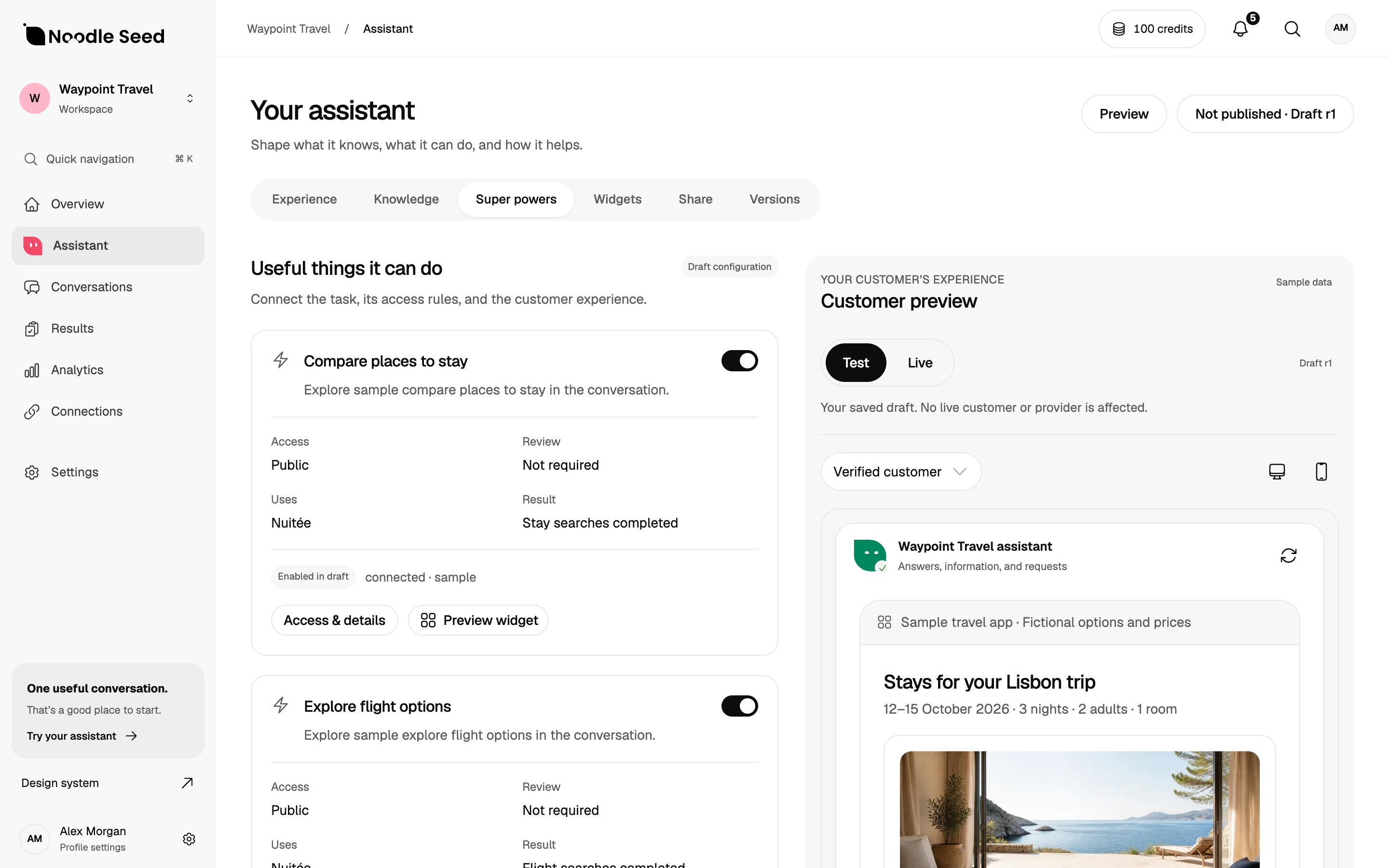
In Noodle Seed, a Super power names the task, who may use it, the system it uses, whether customer review is required, and the expected result. That makes the operating rules part of the setup your team can inspect. The preview lets you rehearse public and verified-customer scenarios before reviewing a version.
Improve the next version with confidence.
A correction should have a clear path from review to release. Noodle Seed’s preview keeps a reviewed answer in draft knowledge, preserves the original conversation, and requires a new test after relevant changes. Versions makes the distinction between the saved draft and selected Live version explicit.
Know what happened after the answer.
Conversations explain the exchange. Results explain what the task did and what confirms it. Business reporting then asks a separate question: which qualifying business outcome occurred, and how was it attributed? Noodle Seed’s preview puts these views beside one another so teams can investigate the whole journey.
Start with your first customer journey.
Early beta preview users are being onboarded to Noodle Seed. Bring the task you want customers to complete, the sources it needs, and the systems it should work with. Use onboarding to agree on the integration scope and rehearse the experience around your business.
Your next steps.
Use this checklist to prepare your evaluation. Checks stay in this page and reset when you leave.
0 of 4 added to your review