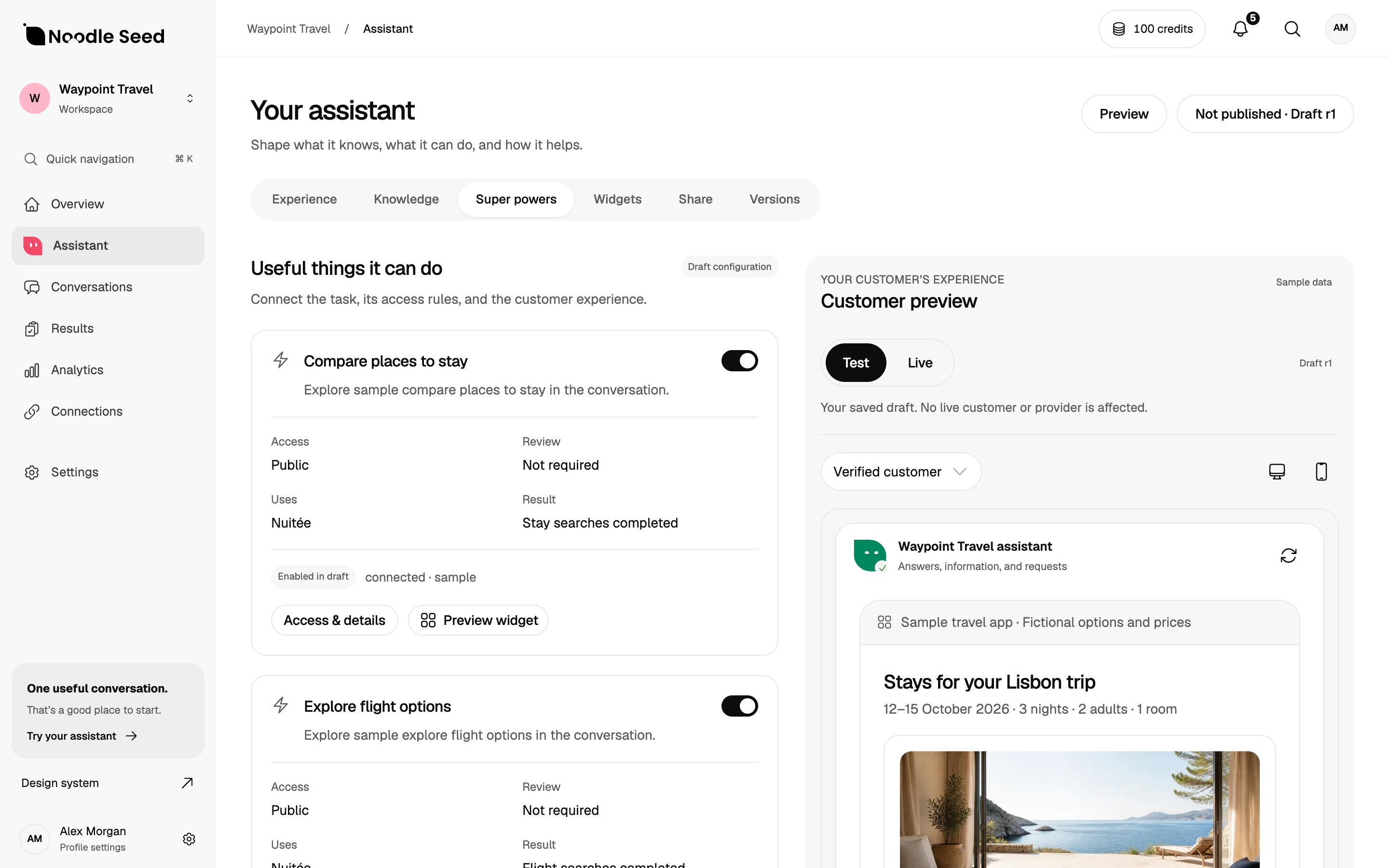
Product guide updated September 16, 2026. Screenshots show the actual workspace with sample data.
Good conversational product discovery connects a customer’s constraints to reliable product information, explains the tradeoff, and offers a next step they can control. Measure whether the customer reaches that next step; a recommendation alone does not prove a purchase.
Start with one decision, and define its finish line.
Choose a recurring question with a bounded answer: which plan supports a particular workflow, which service fits a requirement, or which available option meets a budget. Write down what the assistant needs to know and what would count as a useful result. Keep “options shown,” “request submitted,” and “purchase confirmed” as separate events.
Separate product knowledge from customer records.
Prepare descriptions, policies, eligibility rules, and known limitations in Knowledge. Use an authorized system for changing facts such as availability, account entitlements, or reservation details. A policy document can explain how changes work; it cannot establish whether a particular customer’s reservation can be changed today.
Ask only what changes the recommendation.
Begin with the missing constraint that eliminates unsuitable options. Ask one useful question at a time, preserve the answer, and explain why you need it. If the customer changes their budget or destination, reconsider the recommendation. Avoid asking for identity when a public comparison is sufficient.
Make the next step visible before asking for approval.
Show the selected option, affected record, requested change, and any unresolved condition together. A public comparison may need no account access. Looking up a reservation needs a verified customer; requesting a change may also require review. The permission for one task does not authorize every subsequent task.
Rehearse the journey before choosing what becomes Live.
In Assistant, configure the saved draft, try the relevant customer identity, and test the entire task. Repeat with a missing source, no suitable match, and an unavailable provider. After changing a source or task configuration, test the new draft again. A successful demonstration with sample data does not prove a live account integration.
Follow the evidence back from the result.
Review the conversation for what was asked and explained. Inspect the task result for what completed and what confirms it. Use the underlying business record for a purchase, booking, or account change. If attribution is unknown, retain that uncertainty rather than crediting every sale to the assistant.
Your next steps.
Use this checklist to prepare your evaluation. Checks stay in this page and reset when you leave.
0 of 4 added to your review